Mechanical
Record the glass range, permitted grip areas, loads, transfer path and placement arrangement. Check tooling clearance and the access needed for product removal, cleaning and maintenance.
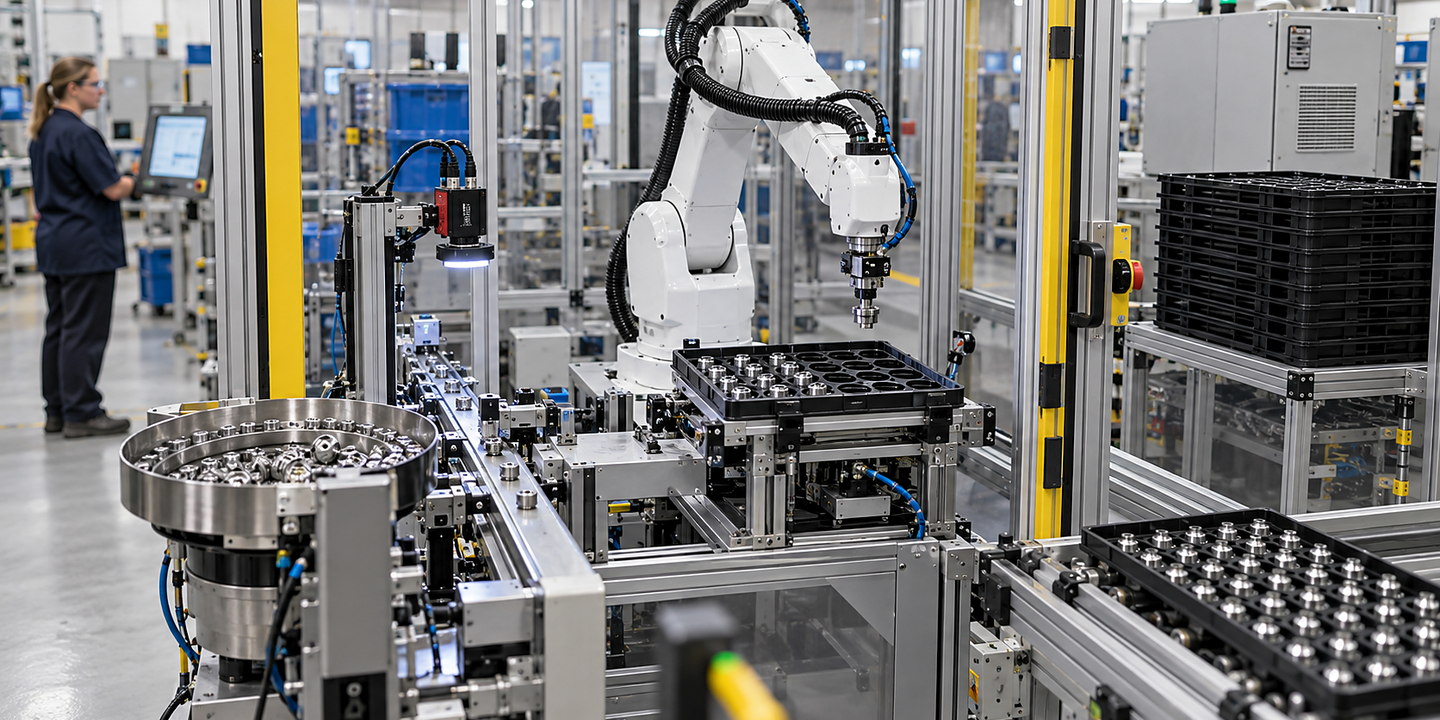
Plan glass handling cell handovers, permitted contact, complete-cycle timing, missing or damaged products, operator access, interrupted transfers and recovery responsibilities.
Map where each glass piece arrives, where tooling may contact it and how it is transferred to the receiving process. Agree line-control and product handover conditions, plus the response to missing or damaged items and interrupted transfers. Review normal operation, operator access and recovery as part of the complete cell.
Use the same product and tooling limits and agreed run-off record throughout integration. Do not infer safe collaborative operation or a particular control protocol from the proposed robot alone.
Plan glass handling robots around your parts, process, cycle time, tooling, recovery and acceptance criteria. Discuss the highest-risk feasibility questions with Oxford Industrial Automation. Your integration review should connect required cycle and production pattern, tooling, sensing and process interfaces and the people who run the process.
Discuss your application

Record the glass range, permitted grip areas, loads, transfer path and placement arrangement. Check tooling clearance and the access needed for product removal, cleaning and maintenance.
Agree supplies, isolation, protective devices, panels and cable routes for the proposed cell and adjacent-process connections; assign ownership of each interface.
Agree arrival and receiving-process conditions, operating modes, handshakes and recipes. Define the response to a missing or damaged piece or an interrupted transfer and who may initiate recovery.
Review the actual tooling, glass products, transfer path and operator tasks in the application assessment. Agree risk controls, stopping, access and reset arrangements for the complete cell.
Agree which sample/product identities, trial conditions, complete-cycle observations and result records are needed, with retention and recovery responsibilities stated.
Review normal operation, product replenishment, interrupted-transfer recovery, clearance, cleaning and changeover with the people responsible. Retain the agreed sequence and training requirements.
For Glass Handling Robots, your team can review each stage before the complete installation is put into routine use.
Record sizes, weights, coatings, permitted contact areas and acceptable product condition. Provide representative pieces and the real arrival and placement arrangements, including the difficult variations.
Trial the proposed tooling with the agreed glass range. Record pickup security, placement accuracy and surface condition at the defined transfer points, retaining the conditions and limitations of each trial.
Agree the layout, line controls, product handovers and responsibilities for missing or damaged items. Include normal operation, changeover, operator access and the complete transfer sequence in the review.
Run agreed normal and difficult scenarios, including interrupted transfers and recovery. Compare the result with the defined placement and condition limits and retain cycle observations, unresolved cases and responsible follow-up.
For your application: check required cycle and production pattern, tooling, sensing and process interfaces, operator access, recovery and changeover, and run-off criteria and production evidence as part of the complete line trial.