In brief

Choose a glass handling application by the actual product range, permitted grip areas and transfer duty. Compare repeatable production with retrofit or flexible-cell requirements using representative glass pieces, pickup and placement trials, condition checks and complete-cycle observations.

Start with the glass handling process and handover responsibilities. These application routes are planning examples; they do not establish a proven installation, a supported product size or a guaranteed handling result.

On the production floor

Match the solution to your product, part and operating needs — Glass Handling Robots

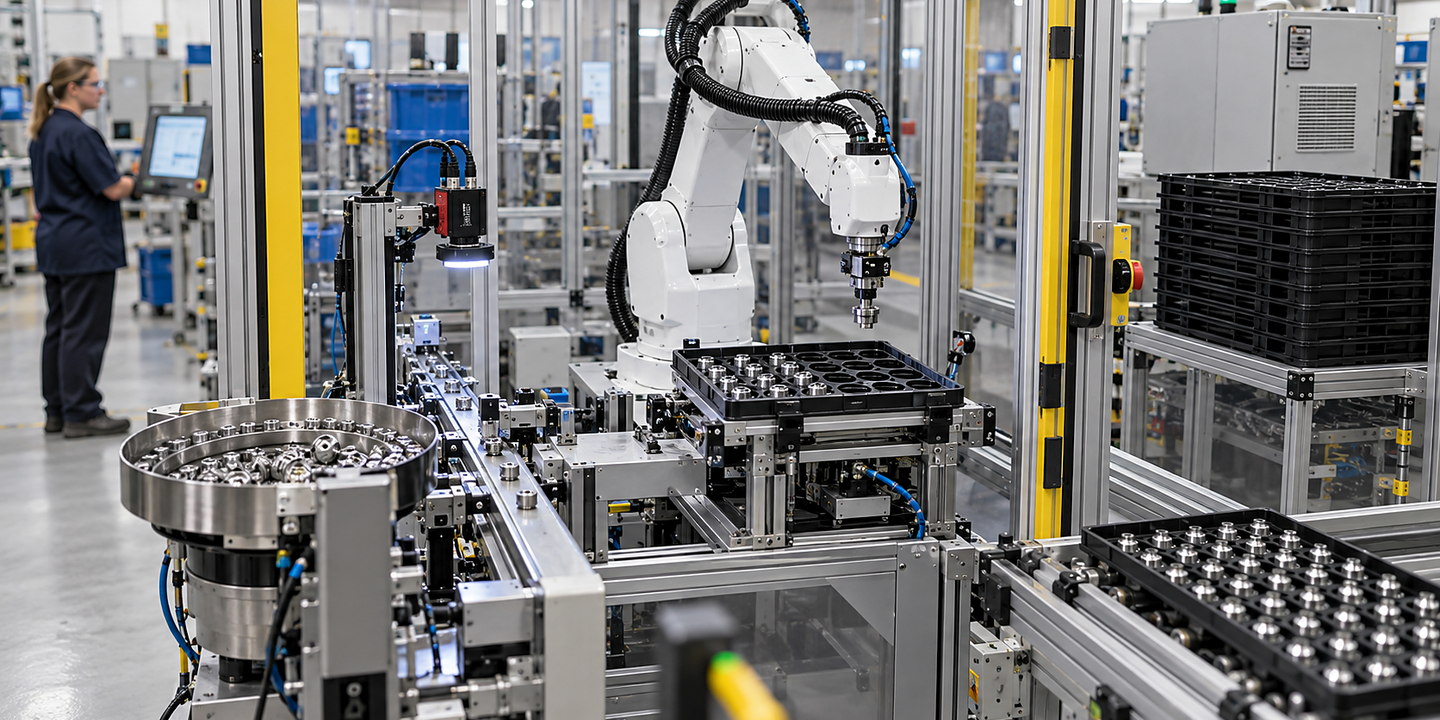
Plan glass handling robots around your parts, process, cycle time, tooling, recovery and acceptance criteria. Discuss the highest-risk feasibility questions with Oxford Industrial Automation. Use the application examples to compare repeatable production using robotic handling of glass products with retrofit or flexible cells involving robotic handling of glass products.

Discuss your application
Application 1

Repeatable Production Using Robotic Handling of Glass Products

Define the glass sizes, weights, coatings and permitted grip areas for the repeated transfer. Trial the real arrival and placement conditions and judge pickup security, surface condition and complete-cycle observations against agreed limits.

Explore this application
Application 2

Retrofit or Flexible Cells Involving Robotic Handling of Glass Products

Map existing equipment, space and handover conditions before selecting a concept. Include the glass range, tooling changeover, access and recovery after an interrupted transfer, and identify which adjacent-process changes are in scope.

Explore this application
Choose the right route

Four questions that can change the recommended approach

What arrives?

Supply representative glass pieces with sizes, weights, coatings and permitted grip areas. Describe arrival variation, missing or damaged items and the actual presentation at the pickup point.

What must happen?

Define the complete transfer path, receiving arrangement and required placement and surface condition. State the production pattern and which interruptions or changes the trial must reproduce.

What surrounds it?

Map neighbouring equipment, available space, services, controls and people. Agree normal handovers and access for clearance, cleaning, maintenance and interrupted-transfer recovery.

What result do you need?

Agree the sample range, repetitions and expected pickup, placement and condition outcomes. Record complete-cycle observations, difficult cases and the owner and action for any unresolved limit.

ApproachOften suitable whenWatch for
Glass Handling RobotsThe product mix and transfer path justify a robotic concept after representative handling trials.Review tooling contact, complete cycle, product condition and application-specific risk controls.
Purpose-Built Mechanical Automation for a Stable, Very High-Volume TaskA stable product range and repeatable transfer justify comparing a dedicated mechanical route.Trial the same glass range and surface-condition limits; a simpler mechanism still needs recovery and access review.
Operator-Assisted Fixtures where Flexibility or Business Case Does Not Support a Robot CellHuman judgement or a changing product mix supports evaluating an assisted handling approach.Review permitted grip areas, product condition, ergonomics and safe access for the actual task.